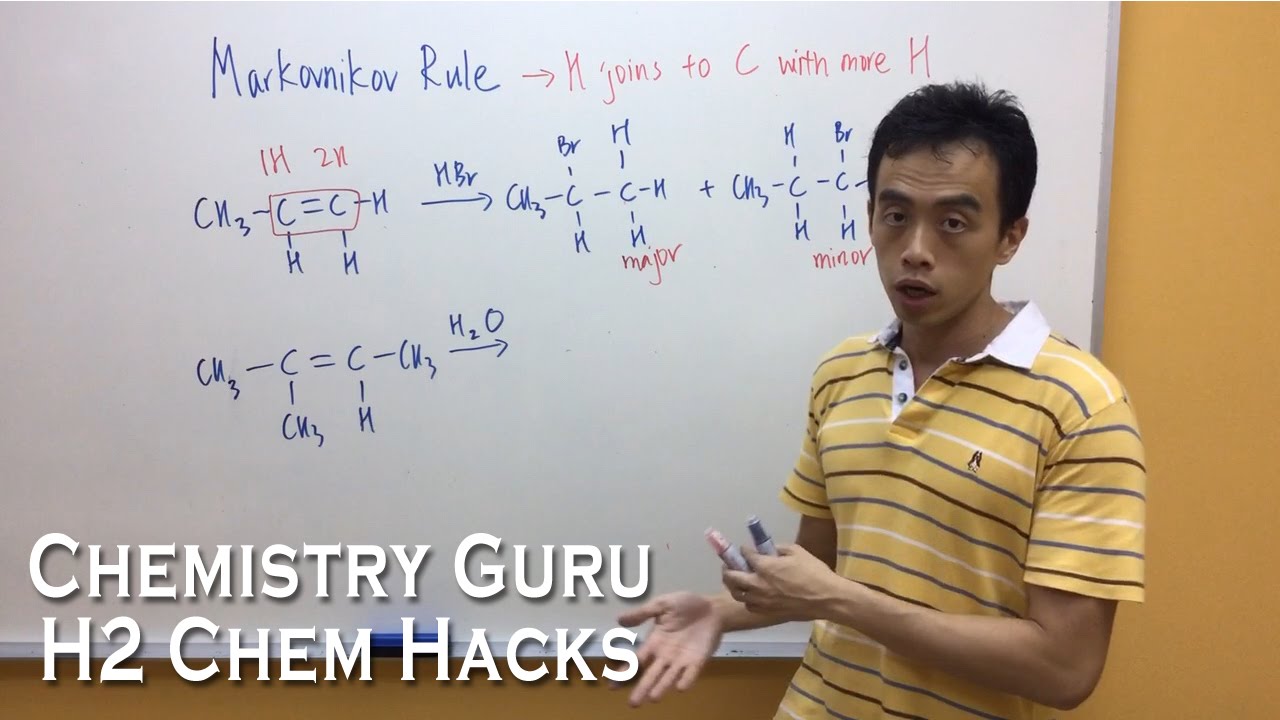
 Alkenes undergo electrophilic addition reactions with reactants such as halogens X2, hydrogen halides HX and water H2O.
When an asymmetrical alkene reacts with an asymmetrical reactant (HX or H2O), two products are possible. We can use the Markovnikov Rule, which states that H is bonded to the Carbon with more H, to predict the major product.
To learn how to apply Markovnikov Rule for Electrophilic Addition of Alkenes, watch this video tutorial now!
Topic - Alkenes, Organic Chemistry, JC, H2, A Level Chemistry, Singapore
Found this video useful? Please LIKE this video and SHARE it with your friends. SUBSCRIBE to my YouTube Channel for new A Level H2 Chemistry video lessons every week!
Any feedback, comments or questions to clarify? Suggestions for new video lessons? Drop them in the COMMENTS Section, I would love to hear from you!
Do you know you can learn Chemistry Concepts under a minute? Follow me on Instagram for my weekly one-minute video lessons at https://www.instagram.com/chemistryguru/
I am also conducting JC H2 Chemistry classes at Bishan Central, Singapore. With my years of experience tutoring hundreds of JC students since 2010, I am confident that I can make H2 Chemistry Simpler for you too! For more information please visit https://chemistryguru.com.sg/
-~-~~-~~~-~~-~-
Please watch my latest video: "Determine Limiting Reagent"
https://www.youtube.com/watch?v=rdJsG...
-~-~~-~~~-~~-~-
How to apply Markovnikov Rule to predict Major Product of Addition of Alkenes - H2ChemHacks | |
| 81 Likes | 81 Dislikes |
| 4,541 views views | 1,940 followers |
| Education | Upload TimePublished on 2 Jun 2015 |

Không có nhận xét nào:
Đăng nhận xét